At hughendenparishcouncil.org.uk, we look at credit card casinos at a different angle: the lifecycle of a casino payment and how it works when being used at credit card casino sites.
Most credit card casino guides begin with a list of payment methods. There’s a more useful way to approach the subject in 2026: follow the money.
What happens from the moment a player chooses £50 in a casino cashier until the money reaches the gambling account? What happens when that player later requests a withdrawal? Which businesses are involved, where can a transaction be declined, and how does the UK’s credit-card gambling ban affect the process?
For British players, these questions matter because UK Gambling Commission licensees have been prohibited from accepting credit card gambling payments since April 2020. The restriction also addresses the use of money-service businesses such as e-wallets where credit-card funds could otherwise be used indirectly.
Here is our latest guide around this entire process.
-
Sign up bonus 101% up to £1001 + 101 FS + 15% CashbackJoin Now
-
Sign up bonus 300% up to £1000 + 150 Free SpinsJoin Now
-
Sign up bonus 400% up to £2,500 + 50 FSJoin Now
-
Sign up bonus 200% up to £2,000 + 100 FS + Royal Wheel SpinJoin Now
-
Sign up bonus 100% up to £2,000 + 100 FSJoin Now
-
Sign up bonus 280% up to £2,550 + 150 FSJoin Now
-
Sign up bonus 175% Bonus up to £1,000 + 100 FSJoin Now
-
Sign up bonus 200% up to £2,000 + 100 FS + 10% Daily CashbackJoin Now
-
Sign up bonus 300% up to £200 + 50 Free Spins + 7% CashbackJoin Now
-
Sign up bonus 125% up to £1,000 + 125 FSJoin Now
-
Sign up bonus 150% Bonus up to £1000 + 50 FSJoin Now
-
Sign up bonus Welcome Bonus Up To £1000 + 100 Free SpinsJoin Now
-
Sign up bonus 200% Matched Bonus up to £2000 + 200 FSJoin Now
-
Sign up bonus 320% Welcome Bonus up to £2,200 + 800 Free SpinsJoin Now
-
Sign up bonus 100% Bonus up to £500 + 100 FSJoin Now
-
Sign up bonus 600% Welcome Bonus Up To £3500 + 250 Free SpinsJoin Now
-
Sign up bonus 290% WELCOME BONUS up to £3,000 + 200 FREE SPINSJoin Now
-
Sign up bonus 150% Bonus up to £1000 + 200 FSJoin Now
-
Sign up bonus 100% Bonus up to £500 + 250 FSJoin Now
-
Sign up bonus 150% Bonus up to £1000 + 300 FSJoin Now




















Credit Card Casinos – Complete Payments Guide for UK Players
Here is our guide around the payment journey when using at credit card casinos and this is covered across a five stage process.
Stage 1: You Open the Casino Cashier
The cashier is effectively the financial centre of an online casino.
A well-designed banking page should immediately tell you:
- Available payment methods
- Minimum deposit
- Maximum deposit
- Supported currencies
- Processing times
- Potential fees
- Withdrawal availability
But there’s one detail that deserves particular attention:
Does “card” mean credit card or debit card?
Visa and Mastercard branding doesn’t answer that question.
Both networks are used for multiple types of payment products, so a UK casino displaying these logos shouldn’t automatically be described as accepting credit cards.
Stage 2: You Choose the Amount
Suppose the player selects:
Deposit: £50
With a debit card, that £50 would ordinarily come from money available through the associated bank account.
A credit card works differently.
The card issuer is effectively extending credit that must subsequently be repaid according to the card agreement.
This difference is fundamental to Britain’s credit-card gambling restrictions.
The Gambling Commission introduced its ban following research into gambling with credit and associated risks of harm.
This creates one of the simplest rules for casino banking:
A credit limit should never be interpreted as an entertainment budget.
Stage 3: The Casino Sends the Transaction for Processing
Clicking Deposit doesn’t normally mean the casino simply takes money directly from a card.
Several organisations can sit between the player and casino.
A simplified transaction might look like:
Player → Casino Cashier → Payment Processor → Card Network → Bank
The approval then travels back through the payment chain.
This explains why a casino can support a particular payment network while an individual transaction is still declined.
Stage 4: The Card Issuer Makes a Decision
The player’s bank or card provider has its own role.
Financial institutions can identify gambling transactions and may impose their own controls.
Some banks provide gambling blocks that customers can activate to prevent gambling-related card transactions.
The Gambling Commission maintains information for consumers about financial-services gambling blocks and other payment controls.
This means casino payment acceptance isn’t solely a decision made by the casino.
Stage 5: Funds Reach the Casino Balance
If an eligible payment is authorised, the casino account is credited.
This is normally the easiest part of the banking journey.
That’s precisely why we think casino reviews focus too heavily on deposits.
A casino accepting money quickly doesn’t tell you very much about its quality.
The real banking test begins when money travels in the opposite direction.
The Reverse Journey: Casino Withdrawals
Imagine the player now has £150 available for withdrawal.
They select:
Withdraw £150
The questions suddenly become more complicated.
Does the casino support payouts to the original payment method?
Does KYC need completing?
Is there an internal pending period?
Does the casino impose a maximum daily payout?
Will the payment processor support the transaction?
This is why we’d introduce a new metric for credit card casino reviews:
The Deposit-to-Withdrawal Ratio
Instead of asking how quickly money enters a casino, compare that with how efficiently it can leave.
For example:
| Casino | Deposit Processing | Withdrawal Processing |
| Casino A | Instant | Same day |
| Casino B | Instant | 1–2 days |
| Casino C | Instant | 3–5 days |
All three advertise “instant payments”.
But only the deposit is instant.
The marketing claim therefore tells only half the story.
Why Withdrawal Information Should Appear Above Bonuses
Casino homepages frequently prioritise:
100% Welcome Bonus
500 Free Spins
VIP Rewards
Banking terms are often much less prominent.
We would reverse that hierarchy.
Before considering a promotion, players should know:
- How withdrawals work.
- What verification is required.
- Whether fees apply.
- Which currencies are supported.
- What payout limits exist.
A large welcome bonus isn’t particularly impressive if withdrawing legitimate funds is unnecessarily difficult.
The Credit Card Casino Transparency Test
Here’s a different way to rate a casino’s banking section.
Give it one point for every question that can be answered without contacting customer support:
| Question | Point |
| Minimum deposit clearly shown? | 1 |
| Maximum deposit shown? | 1 |
| Withdrawal minimum shown? | 1 |
| Withdrawal maximum shown? | 1 |
| Processing times published? | 1 |
| Fees explained? | 1 |
| Supported currencies listed? | 1 |
| KYC policy easy to find? | 1 |
| Card types clearly distinguished? | 1 |
| Responsible-gambling controls accessible? | 1 |
8–10: Excellent transparency
6–7: Reasonable
4–5: More information needed
0–3: Proceed with considerable caution
This measures something much more useful than the number of payment logos displayed in the footer.
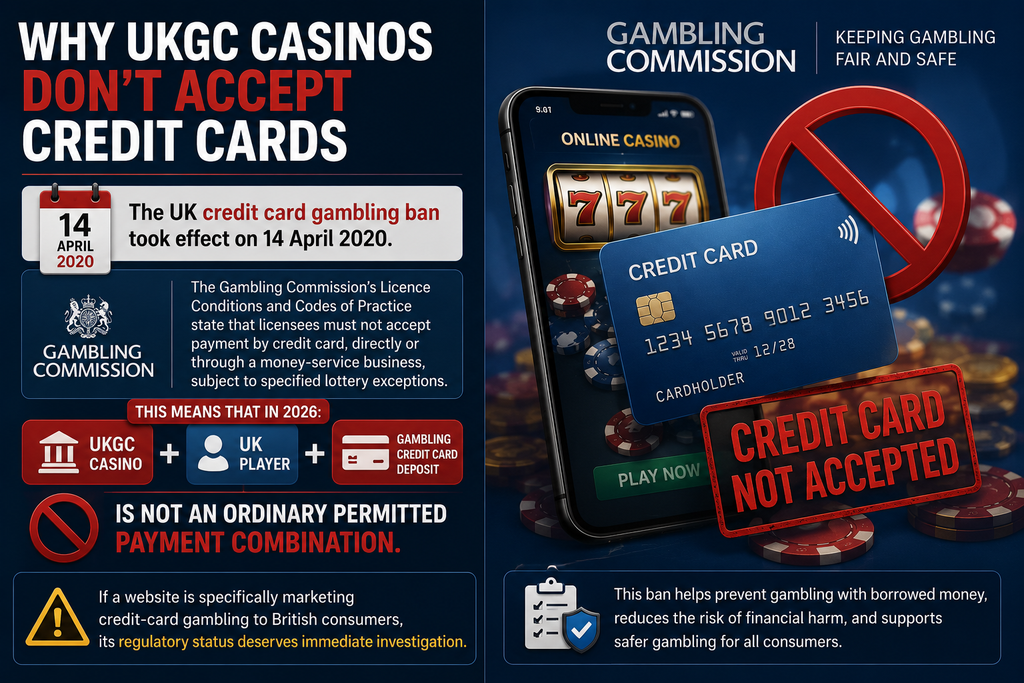
Why UKGC Casinos Don’t Accept Credit Cards
The UK credit card gambling ban took effect on 14 April 2020.
The Gambling Commission’s Licence Conditions and Codes of Practice state that licensees must not accept payment by credit card, directly or through a money-service business, subject to specified lottery exceptions.
This means that in 2026:
UKGC casino + UK player + gambling credit card deposit
is not an ordinary permitted payment combination.
If a website is specifically marketing credit-card gambling to British consumers, its regulatory status deserves immediate investigation.
Why Overseas Casinos Appear in Credit Card Searches
International gambling rules aren’t uniform.
An operator working under another jurisdiction can have different:
- Payment regulations
- Game rules
- Bonus requirements
- Verification procedures
- Responsible-gambling requirements
This explains why UK players researching credit card casinos frequently encounter overseas operators.
However, there’s an important regulatory issue.
The UKGC states that businesses providing remote gambling facilities to consumers in Great Britain require the appropriate operating licence even when based overseas.
Therefore, international licensing should not be presented as equivalent to UK authorisation.
The Four Costs of an International Card Deposit
When researching overseas casinos, players should think about four possible types of cost.
1. Casino Charge
Does the operator impose a deposit fee?
2. Processor Charge
Does an intermediary payment company charge anything?
3. Currency Cost
Is GBP being converted into EUR, USD or another currency?
4. Credit Cost
Where a credit transaction is lawfully available, could the card issuer impose borrowing costs or transaction charges?
The casino cashier may display:
Deposit £100
while the complete financial implications are potentially different.
Checking the card provider’s terms is therefore just as important as checking the casino’s banking page.
Casino Card Security Checklist
Card information is sensitive financial data.
Before entering it, check for several basics.
Secure Connection
The cashier should operate over HTTPS.
Identifiable Operator
You should know which company you’re paying.
Licence Information
The claimed gambling licence should be independently verifiable.
Privacy Policy
The operator should explain how personal and financial information is handled.
Secure Authentication
Additional bank authentication may be used depending on the payment process.
Transaction History
Players should be able to review deposits and withdrawals through their account.
Never provide full card credentials through ordinary email or an unsecured support conversation.
The Casino Payment Red Flag Index
International credit card casino reviews should pay attention to these warning signs.
Payment Logos Without Explanations
Do Visa and Mastercard refer to credit or debit products?
No Published Withdrawal Limits
Players shouldn’t have to deposit before discovering payout restrictions.
Vague Processing Times
“Fast withdrawals” is marketing language, not a timeframe.
Unclear Currency
The account currency should be visible.
Deposit Method Doesn’t Support Payouts
This isn’t necessarily improper, but alternative withdrawal arrangements should be explained.
Unverifiable Licence
A payment option can never compensate for weak regulation.
Pressure to Redeposit
Repeated promotional pressure following losses should be treated cautiously.
What Would the Perfect Casino Banking Page Look Like?
If we were designing one, it would contain a single table:
| Method | Deposit | Withdrawal | Minimum | Maximum | Fees | Processing |
| Debit Card | Yes | Yes/Varies | Clearly shown | Clearly shown | Listed | Listed |
| Bank Payment | Yes | Yes | Clearly shown | Clearly shown | Listed | Listed |
| E-Wallet | Varies | Varies | Clearly shown | Clearly shown | Listed | Listed |
| Prepaid | Varies | Often limited | Clearly shown | Clearly shown | Listed | Listed |
Below it would sit:
Supported countries
Supported currencies
Verification requirements
Withdrawal limits
Responsible-gambling controls
No hidden information. No vague “instant” claims.
The Best Credit Card Casino Feature Isn’t Credit Cards
For UK players, the strongest banking feature is arguably transparency.
A good casino tells you:
- What you can deposit with
- What you can withdraw with
- What everything costs
- How long it should take
- Which limits apply
- What documents could be requested
That information matters more than whether the cashier contains 10, 20 or 30 payment methods.
Credit Card Casino Q&A
Why was my casino card payment declined?
Possible reasons include casino restrictions, card-type restrictions, issuer controls, geographical rules or applicable gambling regulations. A decline doesn’t necessarily indicate a technical fault.
Does a Visa logo prove credit cards are accepted?
No. Visa supports multiple card products, including debit cards.
Why does an overseas casino show payment methods unavailable at UK casinos?
International operators can operate under different regulatory frameworks. That doesn’t mean the operator has equivalent UK authorisation or consumer protections.
Should I check withdrawals before depositing?
Yes. Withdrawal limits, verification, fees and processing times should ideally be understood before money enters the casino.
What’s the most important credit card casino statistic?
For UK players, we’d argue it isn’t deposit speed. Regulatory status and withdrawal transparency provide much more useful information.
Responsible Casino Banking
The payment stage is one of the easiest places to introduce responsible-gambling controls because it’s the point at which money enters the gambling environment.
Before opening the cashier, decide:
Maximum deposit
Maximum session budget
Maximum loss you’re prepared to accept
These should be based on disposable entertainment funds rather than available borrowing.
If a planned £50 deposit becomes £100 because of a loss, and then £200 because the player is attempting to recover that loss, the original budget has stopped functioning.
At that point, stopping the session is more important than changing payment methods.
Deposit limits, banking gambling blocks, time-outs and self-exclusion can provide additional barriers where needed.
